
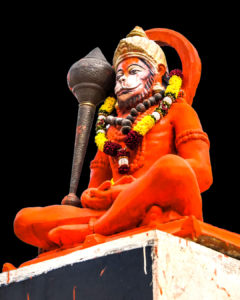
Strength in Devotion: Exploring Verses 23–24 of the Hanuman Chalisa
As we near the final verses of the Hanuman Chalisa, we are invited deeper into the powerful relationship between the devotee and Hanuman—a bond rooted in faith, courage, and unwavering surrender. Verses 23 and 24 speak not only to Hanuman’s extraordinary power but also to the intimate way he walks with those who remember him.
These verses are not abstract poetry; they are living reminders of what becomes possible when we invoke divine strength from a place of love.
Verse 23
“Bhoot pishach nikat nahi aavai,
Mahaveer jab naam sunavai.”
Evil forces and restless spirits cannot approach the devotee who chants the name of Hanuman, the great Mahaveer (mighty hero).
This verse reveals the protective aspect of Hanuman. In the Bhakti tradition, Hanuman is not only revered as the embodiment of strength, but as the guardian of the heart. His very name—when remembered with love—creates a shield against fear, negativity, and inner darkness.
While “bhoot” and “pishach” refer to malevolent spirits, they also symbolize the shadow forces within: doubt, anger, anxiety, and the unconscious habits that pull us away from our true nature. Hanuman’s name becomes a medicine for these afflictions, helping us return to center.
As Maharajji often said, “The name itself has power.”
Chanting Hanuman’s name is more than a ritual—it is a way of aligning ourselves with courage, protection, and clarity. Whether whispered in times of fear or repeated in silent devotion, this practice invites his presence into the landscape of our minds.
Verse 24
“Naasaye rog harai sab peera,
Japat nirantar Hanumat beera.”
He destroys all disease and removes all pain,
For those who continually remember brave Hanuman.
This verse echoes earlier lines in the Chalisa and reinforces a central truth in devotional practice: healing arises not just from action, but from remembrance. “Japat nirantar” means to repeat without ceasing—to live in a rhythm of remembrance.
Hanuman is described as “beera,” the brave one. He is fearless not just in battle, but in love. His devotion to Ram was so complete that fear had no place in him—and through that devotion, he became a channel for healing.
This verse reminds us that the more we align our hearts with Hanuman’s qualities—courage, selfless love, and service—the more space we create for transformation in our own lives.
Healing here can mean the easing of physical pain, but also the softening of emotional and spiritual burdens. In the Bhakti path, healing is not separation from difficulty—it is companionship through it, with divine presence beside you.
Living the Verses
Together, verses 23 and 24 reflect a profound truth: when we remember Hanuman with love and sincerity, we are not alone. His name becomes a companion through shadow and sickness, through fear and fatigue.
As Maharajji showed us through his own presence, the divine doesn’t always remove the obstacle—but it gives us the strength to walk through it.
Let these verses be a reminder: you are protected, you are supported, and you are loved.
And with every repetition of Hanuman’s name, you return to that knowing.
Jai Hanuman. Jai Maharajji.
